Contact us: digitalwages@ilo.org

Digitalized e-contracts and e-wages: A new era for labour rights in Jordan

Jordan has a mixed education system combining public and private provision across basic, secondary and higher education. The private education sector employs around 75,000 workers, most of them women, and educates nearly one in five students in the country (Figure 1). Yet for many years, workers in the sector faced insecure contracts, wage underpayment and limited access to social protection. Today, Jordan is demonstrating how digitalizing employment contracts and wage payments can help transform working conditions while generating valuable labour market data for evidence-based policymaking.
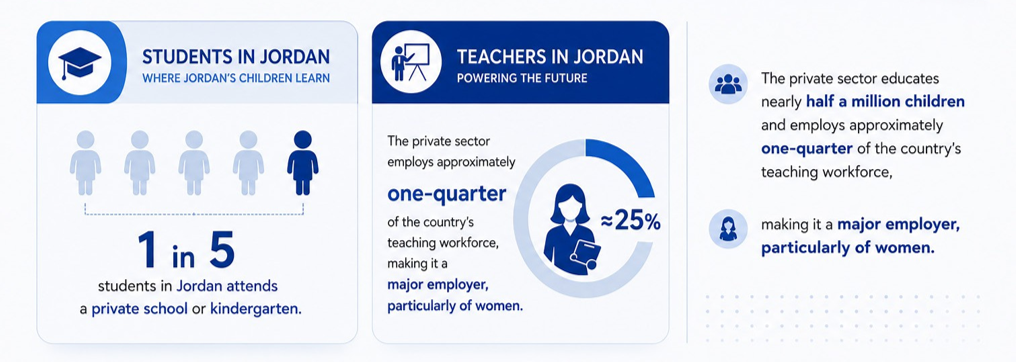
For decades, private education workers, have faced insecure contracts, wage underpayment and limited access to social protection. Common practices such as delayed payment of wages or contract interruptions during the summer months have not only undermined income stability but also weakened workers’ long-term financial security and, for female workers, access to maternity benefits.
In response to these challenges, Jordan has emerged as an example of how digitization of wage payments and employment contract systems can work together to promote decent work. At the heart of this transformation is strong collaboration among national stakeholders, supported by the International Labour Organization (ILO), which has progressively reshaped working conditions in the private education sector.
The reforms were introduced progressively over more than a decade, with each milestone building on the previous one, as shown in Figure 2.
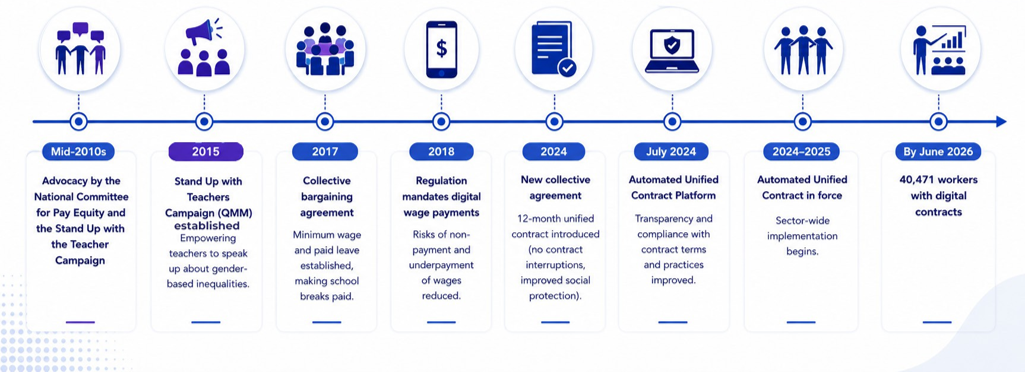
Starting in the mid-2010s, the ILO has supported Jordan’s private education sector through initiatives focused on gender pay equity and wage protection. A major milestone came in 2017, when a collective bargaining agreement between employers and workers’ representatives introduced new labour standards at the sectoral level, including provisions on minimum wages and paid school leave. This agreement was the result of sustained advocacy by the National Committee for Pay Equity, trade unions, civil society organizations and the “Stand Up with the Teacher” campaign, an initiative that empowered teachers to speak up about gender-based inequalities.

In the following year, Jordan took an important step towards improving wage transparency for private school workers. By 2018, a regulation on the Registration and Licensing of Private and International Schools required salaries to be paid digitally, through banks or electronic wallets, reducing the risks associated with cash payments, such as underpayment or non-payment. This reform also strengthened financial accountability and ensured that workers’ earnings were properly recorded for social security purposes. Beyond improving wage protection, the transition to digital payments of wages has contributed to advancing women’s financial inclusion. By ensuring that wages are paid directly into accounts owned and controlled by workers, the reform strengthened women’s economic agency, enhanced their financial security and expanded their participation in the formal financial system.
While the adoption of digital wage payments marked important progress, inconsistencies in employment contracts remained a concern. Teachers often worked under varying terms, with limited monitoring mechanisms to ensure compliance with labour and social security laws.
To address this situation, the Ministry of Labour, trade unions, employers’ associations, the Central Bank of Jordan (CBJ) and the ILO worked together to develop a standardised employment framework. This effort culminated in the creation of a digitalized unified contract for workers in private schools and kindergartens, introduced as part of a new collective agreement that became active at the start of the 2024–2025 academic year. The digitalized contract standardised employment terms across the sector, extending contract duration to 12 months to avoid forced contract interruptions and strengthening safeguards related to wages and social protection.
As Reem Aslan, Programme Manager of the Decent Work for Women Programme in Jordan, notes:
“The development and automation of the unified contract was a landmark achievement towards enhancing justice and transparency in the private education sector in Jordan. Through constructive cooperation between government entities, unions, employers, civil society organizations and the voices of female teachers who champion the cause from the «Stand Up with the Teacher» campaign, we now have a practical model to be followed for the protection of labour rights, particularly for teachers who are the cornerstone of the educational process.”
In addition, in July 2024, Jordan introduced a Unified Contract Platform that enables schools and kindergartens to issue, manage and store contracts digitally, ensuring secure documentation and reducing administrative complexity. The platform has streamlined procedures for both employers and workers by eliminating burdensome paper-based authentication requirements, saving time and costs. For workers, the unified contract platform introduces new safeguards. Teachers and all workers in the private education sector can review and sign contracts digitally, while complaint mechanisms offer secure channels to report abuses without fear of retaliation.

While the platform is hosted by the General Trade Union of Workers in Private Education, it is integrated with services provided by relevant government institutions, including the Ministry of Labour, the Ministry of Education, and the Social Security Corporation, thereby enabling strong oversight and enforcement mechanisms.
As Khalid Fanatseh from the General Trade Union of Workers in Private Education explains:
“The way contracts are documented and processed through a unified electronic platform ensures speed, accuracy and security, within a work environment that is more transparent and better organized, considering the discrepancies and differences in contracts and practices that the sector was witnessing.”
Beyond improving compliance and transparency, the digitalization of wages and contracts is generating an unprecedented source of labour market data for the private education sector. For the first time, policymakers and social partners can obtain near real-time information on the size and gender composition of the workforce in the sector, compliance with the digital wage payment requirement, the pace of adoption of digital contracts (currently standing at 42,376), as well as employment patterns, including wage levels and gender pay gaps across schools, towns, cities, governorates and at the national level.
This data richness can support evidence-based policymaking, strengthen labour market monitoring and inform targeted interventions to address inequalities and irregularities. It also provides valuable insights into the overall contribution of the private education sector to Jordan’s economy, including the volume of wages paid (currently standing at 22 million Jordanian dinars per month), the jobs sustained by private investment in education and the sector’s role in reducing pressure on public schools and government resources (Figure 3).

The transition to digital wage payments and the automation of the unified contract represent a significant milestone for Jordan’s private education sector. While efforts are still needed to enhance the usage of the unified contract platform and compliance with sectoral standards, the progress achieved offers valuable lessons. It highlights the importance of sustained collaboration between government institutions, workers’ and employers’ organizations, the financial sector and international partners, and underscores the potential of digitalizing contracts and wages to strengthen labour rights while generating data for effective labour market governance, gender pay gap analysis and evidence-based policymaking.
By combining digital technologies with regulatory reforms and strong social dialogue, the Jordanian experience in the private education sector stands as a powerful example of how digital transformation can translate into real improvements in people’s working lives. These efforts also contribute to advancing the wage digitization and women’s digital payment usage targets outlined in Jordan’s National Financial Inclusion Strategy (2023-2028), and building digital public infrastructure[1] as part of Jordan’s digital transformation agenda for economic development and social justice.
[1] Such as the Sanad Portal for Digital Government Services, which enables citizens to access digital versions of official identify documents and other government services through a single gateway.