Contact us: digitalwages@ilo.org

Tu Empresa and the ILO promote responsible salary digitization among Peruvian MSMEs | Tu Empresa y OIT impulsan la digitalización responsable de salarios en mipymes peruanas
Lea el artículo en español aquí.
Business advisors from the National Programme Tu Empresa of the Ministry of Production in Peru are strengthening their capacities to support micro, small and medium-sized enterprises (MSMEs) across the country in the responsible digitization of wage payments through training and technical assistance provided with the support of the International Labour Organization (ILO).
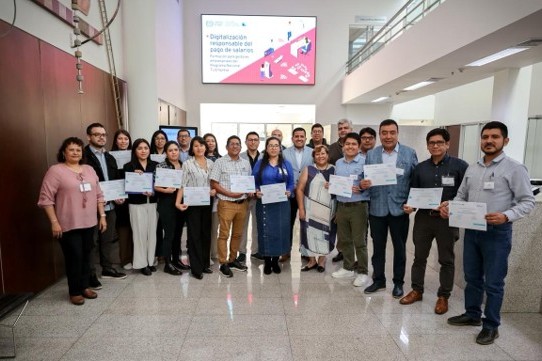
The initiative includes an initial in-person training session for advisors in Metropolitan Lima, held on August 25 and 26, which will be followed by virtual sessions for advisors from different regions of the country. Subsequently, the ILO will provide technical support to help progressively integrate these topics into the services that Tu Empresa provides to MSMEs.
“This first workshop marks the beginning of a pathway that we want to take across the entire country. By strengthening the capacities of our advisors, we multiply our ability to support MSMEs in adopting digital solutions in a practical and responsible way, in line with their needs,” said Christian Flores Magino, Executive Director of Tu Empresa.
Tu Empresa currently has 60 business advisors nationwide, who serve an average of nearly 5,000 businesses each month. The process seeks to leverage this outreach capacity to provide MSMEs with information and tools that enable them to assess the transition from cash-based wage payments to bank accounts or electronic wallets, according to the characteristics of each business and its workforce.
The digitization of wages can reduce the use of cash and facilitate workers’ access to formal financial services. It can also contribute to the formalization of businesses by promoting more organized and transparent wage payment processes, thereby improving productivity and efficiency. The approach promoted by the ILO considers that this transition should place people at the centre by identifying potential barriers and risks, recognizing the different needs of workers, and encouraging consultation and information-sharing processes within each business.
“Digitalizing wages is not simply about replacing cash with a digital payment method: it is about supporting businesses and workers through a responsible, secure and sustainable transition, with an approach that combines business efficiency, transparency, financial inclusion and decent work,” said Thomas Wissing, Deputy Director of the ILO Office for the Andean Countries.
The training sessions in Lima covered the functioning of the digital wage payments ecosystem, its benefits and challenges, the conditions required for a responsible transition, aspects related to payroll systems, worker registration and the issuance of payslips, and relationships with financial and payroll service providers. The methodology combines technical content with case analysis, practical exercises, discussions and action planning related to business advisory services.
This work forms part of the technical assistance provided by the ILO’s Global Centre on Digital Wages for Decent Work to the National Programme Tu Empresa and is linked to efforts by Peruvian institutions to expand the use of digital payments.
Through in-person training, virtual sessions and subsequent technical support, both institutions seek to strengthen capacities within Tu Empresa so that responsible wage digitization can be progressively incorporated into the advisory services provided to MSMEs across the country.